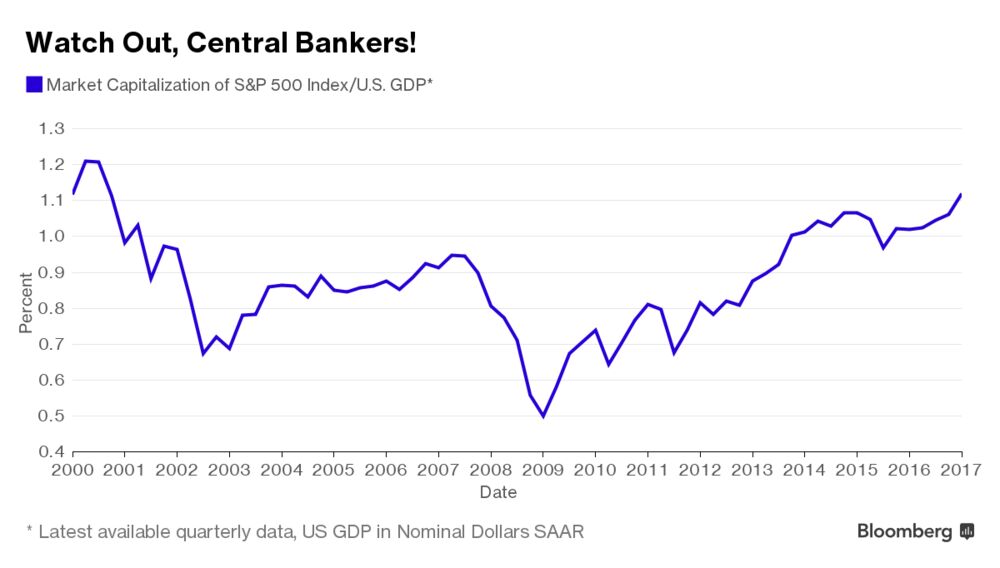
It's Not About Rates, It's about Bank Hoarding
Gold seemingly moves counter to rate hikes at this point in
the rate cycle. But Gold is moving in unison with increasing monetary
velocity
In Summary:
- rate hikes effect non-deployed cash assets
- a rise in rates spurs banks to make loans due to opportunity cost
- Main street finally gets access to money banks otherwise squirrel away
- the velocity of money increases and inflation upticks
Then
- Real rates remain negative as prices rise
- Stocks begin to suffer, Gold benefits
- In the next rate hike cyccle we get acceleration as Inflation is now running away
- Finally we get a Volcker who stops it.
- In between however, we will ger a QE4 to slow stock market price descent
We believe that in addition to global political uncertainty,
Gold is being predictive of increased money velocity that will be a
function of Bank excess reserves being deployed due to Fedrate hikes. In
short
- Political uncertainty is getting in the way of our ability to buy Gold cheaper
- Any Global resolution will likelycause a minor exodus from Gold
- That is a dip to buy in preparation for the changes in M2 coming
More Money is Printed. Less is being used
M2 is Low because banks are sitting on excess cash. Rte hikes force them to use it.
The Great Interest Rate Illusion
via Lee Adler and thedailyreckoning
Now that the Fed went ahead and done what all the Fedheads had said
that they would do on March 15, the question is, what did the Fed
actuallydo?
Did they tighten credit? No.
Did they reduce the size of the Fed’s balance sheet? No.
Did they decrease the growth rate of the money supply? No.
Did they raise interest rates?
No.
That last one may surprise you. I just said the Fed didn’t raise interest rates.
What do I mean?
Raising interest rates means raising banks’ costs of funds so that the banks will charge their customers higher rates.
Banks make money when the amount of interest they can charge on the
loans they make exceeds the amount of interest they have to pay
depositors (savings, checking, etc.) — the cost of funds.
The key takeaway is that, the lower the cost of funds, the more money banks make on the loans they make. And vice versa.
But the Fed hasn’t raised banks’ cost of funds at all. In fact, it’s lowered them.
The Fed has merely increased the Interest on Excess Reserves (IOER)
that it pays the banks for their $2.7 trillion in reserve deposits at
the Fed.
IOER is a de facto subsidy the Fed pays to the banks for the couple
trillion in reserve deposits they hold at the Fed. Increasing it
increases the cash subsidy to the banks.
Increasing the amount of interest the Fed pays on those reserves
isn’t a tightening. That’s because raising IOER doesn’t raise the banks’
cost of funds. It lowers it.
Raising IOER does not make it more difficult for the banks to make
loans. It makes it easier. It increases their profits. By lowering their
costs and increasing their profits, increasing IOER makes it easier for
banks to make loans, not harder.
In other words, the Fed hasn’t been raising bank costs at all since
it began this rate cycle. Au contraire. The Fed has been increasing the
interest it pays on excess reserves.
Essentially, the Fed isn’t tightening. It’s easing. But the market doesn’t see it.
It’s as if the Fed is the hypnotist and money market traders are the subjects of a great experiment in mass hypnosis.
The Fed had essentially told the market, “Keep your eyes on the
spiral. You are getting sleepy, very sleepy. Now you believe that
interest rates are rising.” This was a done deal for the March FOMC
meeting, with more to follow.
Traders believe that the Fed has tightened, so they act as if the market is in fact tighter.
But money is really much looser than the Fed would have us believe.
There has been no tightening because the Fed has not removed one dime
of the massive excess cash it pumped into the banks over the course of
QE. That pile of excess cash means that there are no restraints on loan
growth other than borrowers desire to borrow.
So, while the Fed did not tighten money one iota, rates moved up because of the power of suggestion.
With trillions in excess cash lying around the Fed can only suggest.
What will the Fed do when the market wakes up? And how would the
markets react to the reality that the Fed really doesn’t control
interest rates at all?
Illusions don’t last forever.
But let’s just assume for the moment that the Fed actually did raise rates, does that mean the bubble will stop expanding?
Actually, no.
In the early and mid stages of a credit tightening cycle — which is
what we’re in right now — such increases do nothing to reduce lending or
curb speculative fervor.
In fact, in an inflationary environment, raising rates normally even
leads to increased lending, increased speculation, and increased
inflation!
All things that the Fed purportedly wants to curb.
Speculative lending won’t be curtailed, and unfortunately, the stock
market blowoff may prove more persistent. Eventually that will only lead
to a bigger more intractable collapse.
If you don’t believe me, I can tell you that I’m old enough to have
lived through just such a period as a young adult starting my career on
Wall Street in the 1970s. More recently it happened in the Fed’s last
tightening cycle from 2004 to 2006.
Greenspan raised the Fed Funds target from 1% to 5%. The consumer
price index (CPI) rose from 1.6% to a peak of 4.6% in September 2005,
and stayed at 3.5% or higher until the end of the rate increase cycle.
The increase in lending rates was supposed to slow credit growth. What happened? It grew faster.
Loan growth was already red hot at near 7% at the beginning of the
rate increases. By the end of 2005, loan growth was skyrocketing at an
annual rate of more than 13%. We were in the midst of the greatest
credit bubble in history. Finally, the S&P 500 was around 1125 at
the beginning of the rate increase cycle in 2004. It rose to over 1300
in the middle of 2006, about a 16% increase.
So much for interest rate increases tightening credit, slowing
speculation, or reducing inflation. In fact just the opposite occurred
over that 2 year period.
We all remember the late Great Housing Bubble (not to be confused
with the current great housing bubble — lower case). According to the
Federal Housing Finance Agency (FHFA), house prices inflated by an
average 17% nationally during those 2 years. And FHFA’s methodology
suppresses the rate of increase. The hot bubble markets went up 25-30%
per year!
So we don’t need to go back to the 1970s to know that raising
interest rates doesn’t slow inflation and doesn’t slow lending. We
learned that very well again in the 2004-2006 experience. And we also
learned especially that raising interest rates does not slow speculative
bubbles.
In fact, rates never became punitive during the Great Housing Bubble,
like they did under Paul Volcker in the early 1980s. In 2006, home
prices were still rising at a rate well above the Fed Funds rate. The
Bubble died of too much bad credit. The financial system crashed because
it had fraudulently lent too much money under false pretenses.
Once it became clear that too much bad debt had been created, the
financial system collapsed. It wasn’t because of high interest rates.
So the idea that the Fed raising rates will reign in speculation,
curtail lending and keep inflation in check is patently absurd. Raising
rates without actually tightening credit, could do the exact opposite
just as it has in the past.
No two cycles are exactly alike, but if past is prologue, this rate
cycle will cause an increase in the amount of speculative borrowing.
It’s too early to tell how this will play out and how the financial
markets will respond. I suspect that this will end badly because it’s
based on a fraud perpetrated by the Fed.
So far, money market traders have bought in, but the pressures of reality will soon intrude on the fantasy.
Then the mass illusion currently in effect will end with a bang.
Lee Adler for
The Daily Reckoning