
Investor. Any references to securities are not recommendations or solicitations to buy or sell anything. I may have positions in securities mentioned.
Wednesday, November 25, 2015
 Alive
Alive

Tuesday, November 24, 2015
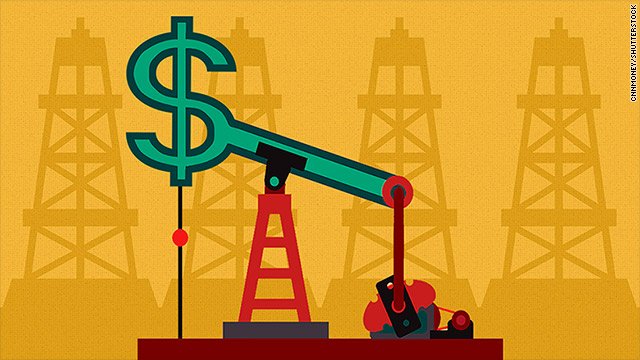
How much does it cost to produce a barrell of oil?
It costs $36.20 to produce one barrel of #oil in the U.S. How about the rest of the world? http://cnnmon.ie/1MP7w6K



Monday, November 23, 2015
How Yogi Berra's 'Yogi-isms' Apply to Investing
Oaktree Capital Group co-Chairman Howard Marks discusses how emotion and human nature play into investing. He speaks on "Bloomberg ‹GO›." (Source: Bloomberg)
http://www.bloomberg.com/news/videos/2015-11-20/how-yogi-berra-s-yogi-isms-apply-to-investing
Saturday, November 21, 2015
Goldman Sachs/Fed revolving door map.
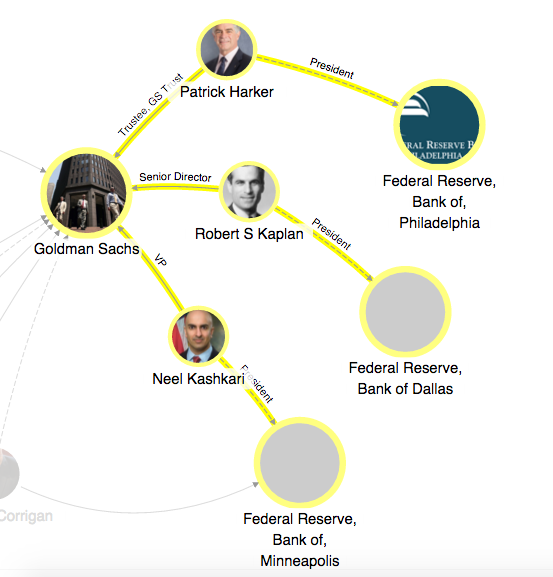
A new take on our Goldman Sachs/Fed revolving door map.
Take a look: http://littlesis.org/maps/1120-goldman-sachs-alum-run-the-fed …
Russian Ruble
Goldman Sachs advises to buy Russian ruble in 2016

The US investment bank predicts the ruble will be on the list of
good performing currencies next year along with the US dollar and the
Mexican peso, Bloomberg reports.
Goldman Sachs recommends buying Russian and Mexican currencies over South Africa’s rand and Chile’s peso.
This week, the ruble has grown three percent, but seems not strong enough to continue the trend in 2015.
“Ruble assets have found useful support over the last week on a perceived rapprochement between Russia and the West. This relationship may, however, will be tested over the coming days and weeks as fundamentals continue to be weak, oil prices remain under pressure and a December Fed liftoff seems increasingly likely,”
Ivan Tchakarov, economist at Citigroup told Bloomberg.
Goldman Sachs also said the greenback would grow in value in 2016 against the euro and yen. In 2015, the dollar has been growing compared to all of its peers, as the US Federal Reserve gets closer to hiking interest rates and the European Central Bank and Bank of Japan continued monetary stimulus.
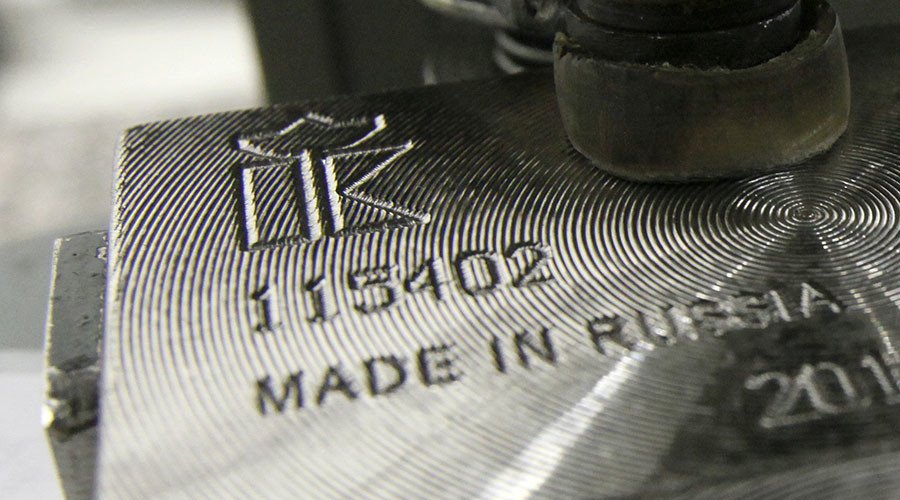
Ruble will make 'Made in Russia' a global brand – World Bank economist http://on.rt.com/6vjf
This week, the ruble has grown three percent, but seems not strong enough to continue the trend in 2015.
“Ruble assets have found useful support over the last week on a perceived rapprochement between Russia and the West. This relationship may, however, will be tested over the coming days and weeks as fundamentals continue to be weak, oil prices remain under pressure and a December Fed liftoff seems increasingly likely,”
Ivan Tchakarov, economist at Citigroup told Bloomberg.
Goldman Sachs also said the greenback would grow in value in 2016 against the euro and yen. In 2015, the dollar has been growing compared to all of its peers, as the US Federal Reserve gets closer to hiking interest rates and the European Central Bank and Bank of Japan continued monetary stimulus.
Ruble will make 'Made in Russia' a global brand – World Bank economist http://on.rt.com/6vjf
Ruble will make 'Made in Russia' a global brand – World Bank economist http://on.rt.com/6vjf
Tuesday, November 17, 2015
Climate finance rose 18% last year
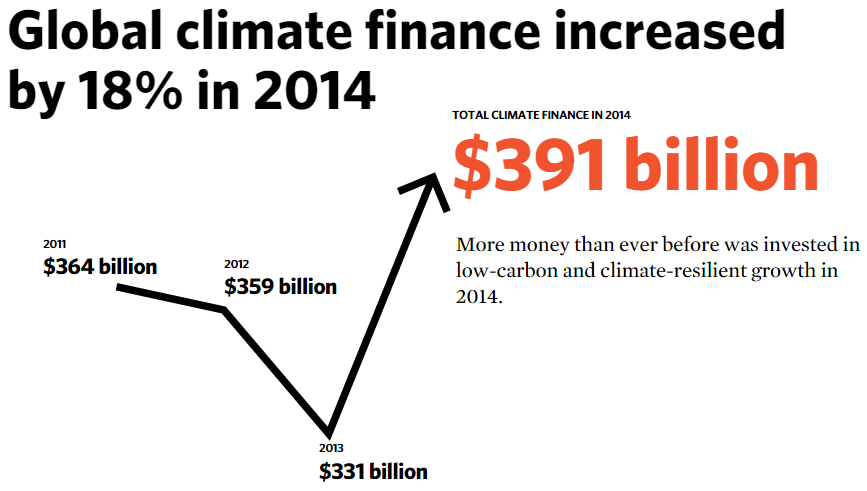
Climate finance rose 18% last year to reach $391 billion, with $292bn in renewable energy:
Wednesday, November 11, 2015
Financial Secrecy Index
Introduction
| The
Financial Secrecy Index ranks jurisdictions according to their secrecy
and the scale of their offshore finanical activities. A politically
neutral ranking, it is a tool for understanding global financial
secrecy, tax havens or secrecy jurisdictions, and illicit financial
flows or capital flight. The index was launched on November 2, 2015. Shining light into dark places An estimated $21 to $32 trillion of private financial wealth is located, untaxed or lightly taxed, in secrecy jurisdictions around the world. Secrecy jurisdictions - a term we often use as an alternative to the more widely used term tax havens - use secrecy to attract illicit and illegitimate or abusive financial flows. Illicit cross-border financial flows have been estimated at $1-1.6 trillion per year: dwarfing the US$135 billion or so in global foreign aid. Since the 1970s African countries alone have lost over $1 trillion in capital flight, while combined external debts are less than $200 billion. So Africa is a major net creditor to the world - but its assets are in the hands of a wealthy élites, protected by offshore secrecy; while the debts are shouldered by broad African populations. Yet all rich countries suffer too. For example, European countries like Greece, Italy and Portugal have been brought to their partly knees by decades of tax evasion and state looting via offshore secrecy. A global industry has developed involving the world's biggest banks, law practices, accounting firms and specialist providers who design and market secretive offshore structures for their tax- and law-dodging clients. 'Competition' between jurisdictions to provide secrecy facilities has, particularly since the era of financial globalisation really took off in the 1980s, become a central feature of global financial markets. The problems go far beyond tax. In providing secrecy, the offshore world corrupts and distorts markets and investments, shaping them in ways that have nothing to do with efficiency. The secrecy world creates a criminogenic hothouse for multiple evils including fraud, tax cheating, escape from financial regulations, embezzlement, insider dealing, bribery, money laundering, and plenty more. It provides multiple ways for insiders to extract wealth at the expense of societies, creating political impunity and undermining the healthy 'no taxation without representation' bargain that has underpinned the growth of accountable modern nation states. Many poorer countries, deprived of tax and haemorrhaging capital into secrecy jurisdictions, rely on foreign aid handouts. This hurts citizens of rich and poor countries alike. |
| ||||||||||||||||||||||||||||||||||||||
In identifying the most important providers of international financial secrecy, the Financial Secrecy Index reveals that traditional stereotypes of tax havens are misconceived. The world’s most important providers of financial secrecy harbouring looted assets are mostly not small, palm-fringed islands as many suppose, but some of the world’s biggest and wealthiest countries. Rich OECD member countries and their satellites are the main recipients of or conduits for these illicit flows.
The implications for global power politics are clearly enormous, and help explain why for so many years international efforts to crack down on tax havens and financial secrecy were so ineffective, it is the recipients of these gigantic inflows that set the rules of the game.
Yet our analysis also reveals that recently things have genuinely started to improve. The global financial crisis and ensuing economic crisis, combined with recent activism and exposure of these problems by civil society actors and the media, and rising concerns about inequality in many countries, have created a set of political conditions unparalleled in history. The world's politicians have been forced to take notice of tax havens. For the first time since we first created our index in 2009, we can say that something of a sea change is underway.
World leaders are now routinely talking about the scourges of financial secrecy and tax havens, and putting into place new mechanisms to tackle the problem. For the first time the G20 countries have mandated the OECD to put together a new global system of automatic information exchange to help countries find out about the cross-border holdings of their taxpayers and criminals. This scheme is now being rolled out, with first information due to be exchanged in 2017.
Yet of course these schemes are full of loopholes and shortcomings: many countries are planning to pay only lip service to them, if that -- and many are actively seeking ways to undermine progress, with the help of a professional infrastructure of secrecy enablers. The edifice of global financial secrecy has been weakened - but it remains fully alive and hugely destructive. Despite what you may have read in the media, Swiss banking secrecy is far from dead. Without sustained political pressure from millions of people, the momentum could be lost.
The only realistic way to address these problems comprehensively is to tackle them at root: by directly confronting offshore secrecy and the global infrastructure that creates it. A first step towards this goal is to identify as accurately as possible the jurisdictions that make it their business to provide offshore secrecy.
This is what the FSI does. It is the product of years of detailed research by a dedicated team, and there is nothing else like it out there. We also have a set of unique reports outlining detailed offshore histories of the biggest players in the game.
Click here for the full 2015 ranking. For further questions, click here.
Burger Machine That Wants Your Job
Attention Fast Food Strikers: Meet The Burger Machine That Wants Your Job
by ZeroHedge •
By Tyler Durden at ZeroHedge
Today, U.S. fast-food workers will strike across 270 cities in a protest for higher wages and union rights that they hope will catch the attention of candidates in 2016 elections, organizers said.
The walkouts will be followed by protests in 500 cities by low-wage workers in such sectors as fast food and home and child care, a statement by organizers of the Fight for $15 campaign said on Monday.
The protests and strikes are aimed at gaining candidates’ support heading into the 2016 election for a minimum wage of $15 an hour and union rights, it said.
The strikes and protests will include workers from McDonald’s, Wendy’s, Burger King , KFC and other restaurants, the statement said.
And while we sympathize with their demands for higher wages, here is the simple reason why they will be very much futile.
Dear fast food workers of the US – presenting you nemesis: the Momentum Machines burger maker.
According to a recent BofA reported on how robotics will reshape the world, San Francisco start up Momentum Machines are out to fully automate the production of burgers with the aim of replacing a human fast food worker. The machine can shape burgers from ground meat, grill them to order with the specified amount of char, toast buns, add tomatoes, onions, pickles, and finally place it on a conveyor belt.
The robot is shown below. It occupies 24 square feet, and is much smaller and efficient than most assembly-line fast-food operations. It provides “gourmet cooking methods never before used in a fast food restaurant” and will deposit the completed burger into a bag. It does all of this without a trace of attitude.

According to public data, the company’s robot can “slice toppings like tomatoes and pickles immediately before it places the slice onto your burger, giving you the freshest burger possible.” Unlike human workers, the robot is “more consistent, more sanitary, and can produce ~360 hamburgers per hour” or a burger every 10 seconds.
Furthermore, future generations of the device “will offer custom meat grinds for every single customer. Want a patty with 1/3 pork and 2/3 bison ground to order? No problem.”
As the company’s website adds, “our various technologies can produce an ever-growing list of common choices like salads, sandwiches, hamburgers, and many other multi-ingredient foods with a gourmet focus.”
But most importantly, it has no wage demands: once one is purchashed it will work with 100% efficiency for years. And it never goes on strike.
As the company’s co-founder Alexandros Vardakostas told Xconomy his “device isn’t meant to make employees more efficient. It’s meant to completely obviate them.”

The company’s philosophy on making millions of fast food workers obsolete:

Finally, for those complaining that there will be no “human touch” left to take the orders, robots have that covered too:

And now it’s time to calculate how many tens if not hundreds of billions in additional welfare spending these soon to be unemployed millions in low-skilled workers will cost US taxpayers.
Source: Dear Striking Fast-Food Workers: Meet the Machine That Just Put You Out Of A Job – ZeroHedge
Today, U.S. fast-food workers will strike across 270 cities in a protest for higher wages and union rights that they hope will catch the attention of candidates in 2016 elections, organizers said.
The walkouts will be followed by protests in 500 cities by low-wage workers in such sectors as fast food and home and child care, a statement by organizers of the Fight for $15 campaign said on Monday.
The protests and strikes are aimed at gaining candidates’ support heading into the 2016 election for a minimum wage of $15 an hour and union rights, it said.
The strikes and protests will include workers from McDonald’s, Wendy’s, Burger King , KFC and other restaurants, the statement said.
And while we sympathize with their demands for higher wages, here is the simple reason why they will be very much futile.
Dear fast food workers of the US – presenting you nemesis: the Momentum Machines burger maker.
According to a recent BofA reported on how robotics will reshape the world, San Francisco start up Momentum Machines are out to fully automate the production of burgers with the aim of replacing a human fast food worker. The machine can shape burgers from ground meat, grill them to order with the specified amount of char, toast buns, add tomatoes, onions, pickles, and finally place it on a conveyor belt.
The robot is shown below. It occupies 24 square feet, and is much smaller and efficient than most assembly-line fast-food operations. It provides “gourmet cooking methods never before used in a fast food restaurant” and will deposit the completed burger into a bag. It does all of this without a trace of attitude.
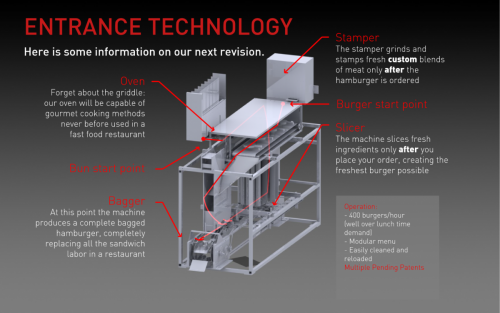
According to public data, the company’s robot can “slice toppings like tomatoes and pickles immediately before it places the slice onto your burger, giving you the freshest burger possible.” Unlike human workers, the robot is “more consistent, more sanitary, and can produce ~360 hamburgers per hour” or a burger every 10 seconds.
Furthermore, future generations of the device “will offer custom meat grinds for every single customer. Want a patty with 1/3 pork and 2/3 bison ground to order? No problem.”
As the company’s website adds, “our various technologies can produce an ever-growing list of common choices like salads, sandwiches, hamburgers, and many other multi-ingredient foods with a gourmet focus.”
But most importantly, it has no wage demands: once one is purchashed it will work with 100% efficiency for years. And it never goes on strike.
As the company’s co-founder Alexandros Vardakostas told Xconomy his “device isn’t meant to make employees more efficient. It’s meant to completely obviate them.”
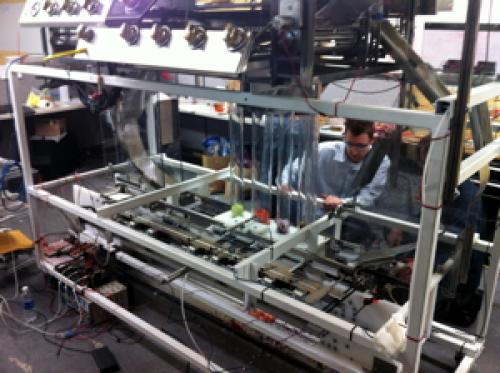
The company’s philosophy on making millions of fast food workers obsolete:
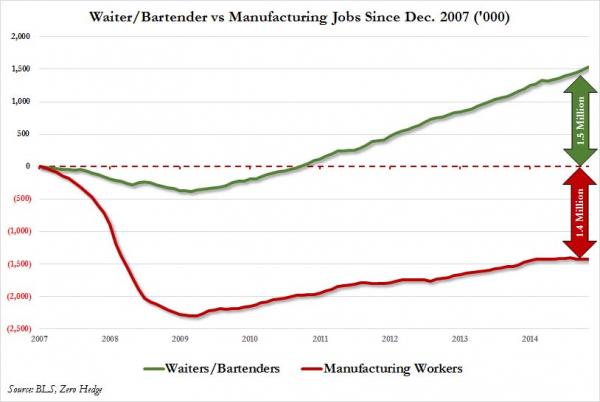
This is a major problem for the US economy, which once built on a manufacturing backbone, has seen the fastest jobs growth in recent years for workers employed by “food service and drinking places” i.e., fast food workers, waiters and bartenders.The issue of machines and job displacement has been around for centuries and economists generally accept that technology like ours actually causes an increase in employment.The three factors that contribute to this are
- the company that makes the robots must hire new employees,
- the restaurant that uses our robots can expand their frontiers of production which requires hiring more people, and
- the general public saves money on the reduced cost of our burgers. This saved money can then be spent on the rest of the economy.
Finally, for those complaining that there will be no “human touch” left to take the orders, robots have that covered too:

And now it’s time to calculate how many tens if not hundreds of billions in additional welfare spending these soon to be unemployed millions in low-skilled workers will cost US taxpayers.
Source: Dear Striking Fast-Food Workers: Meet the Machine That Just Put You Out Of A Job – ZeroHedge
Subscribe to:
Posts (Atom)