Investor. Any references to securities are not recommendations or solicitations to buy or sell anything. I may have positions in securities mentioned.
Greed and Capitalism
What kind of society isn't structured on greed? The problem of social organization is how to set up an arrangement under which greed will do the least harm; capitalism is that kind of a system.
Inside Canada’s Push to Contain the Fallout From Home Capital
by
Josh Wingrove
Finance minister pored over issue before calling big bank CEOs
Regulator steps up vigilance as analysts warn of contagion
As Home Capital Group Inc.’s shares were in freefall last week, the fight to stop the bleeding at the Canadian mortgage lender had already begun.
It
was late Tuesday night, Ottawa time, when federal Finance Minister Bill
Morneau received his first briefing from department officials just as
he was boarding a plane in Beijing to head home.
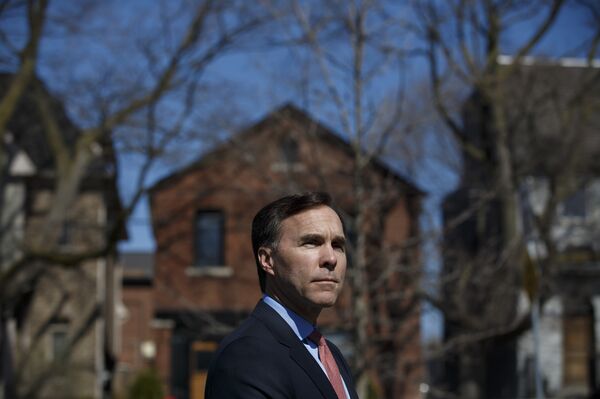
Bill Morneau
Photographer: Cole Burston/Bloomberg
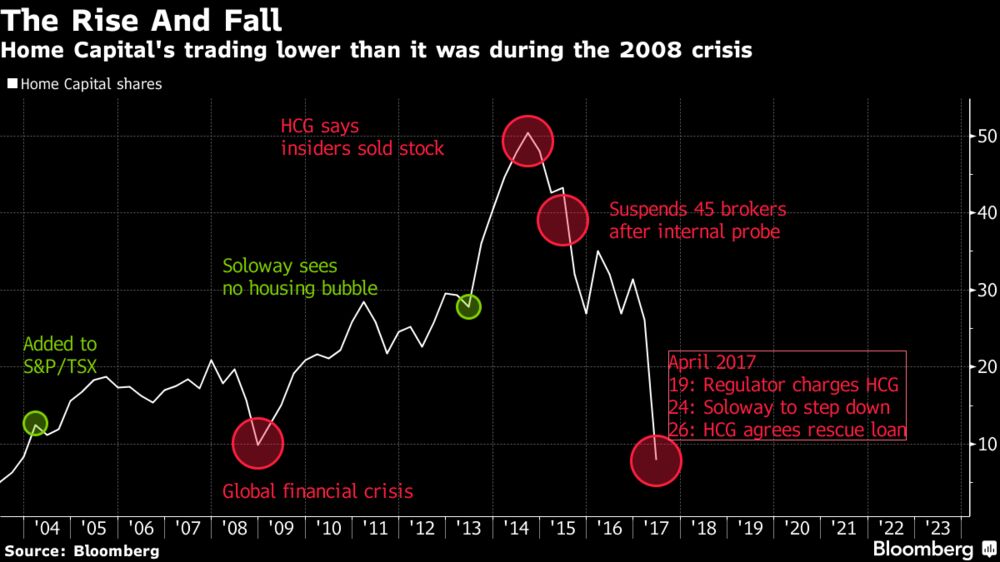
Home Capital had been reeling for a week after the Ontario Securities Commission accused the company of misleading investors
over fraudulent mortgages. That was sparking a run on deposits, forcing
the company to take on a C$2 billion ($1.5 billion) emergency credit
line at an effective interest rate of 22.5 percent on funds drawn so
far.
Last Wednesday, with Morneau en route home, Home Capital’s
shares dropped 60 percent by lunchtime as investors bet the onerous
terms of the loan would squeeze the company. There was also contagion
risk. Canada’s major banks saw their shares slump, while Equitable Group Inc., a rival of Home Capital, plunged by almost a third.
Morneau
landed in Ottawa Wednesday night, calling his departmental officials as
he got off the plane for the latest information, according to people
familiar with the discussions. He later spoke with Jeremy Rudin, head of
Canada’s Office of the Superintendent of Financial Institutions, who is
responsible for regulating what the World Economic Forum has called the
“soundest” banking system.
On
Thursday, Morneau’s office pledged his support for Rudin’s OSFI and the
banking sector. “Our government has full confidence” in OSFI to “manage
the situation,” Morneau spokeswoman Annie Donolo said in an email.
The
pledge wasn’t enough to calm investors. While Home Capital’s stock
recovered on Thursday on speculation a buyer for the company might
emerge, the deposit run continued, totaling C$892 million over three
days to close the week. What’s more, the onerous terms of the high-interest lifeline, later revealed by Bloomberg News to be from Healthcare of Ontario Pension Plan, resonated beyond the company.
Run on Deposits
“We
looked and felt, what on earth are they doing?” Equitable Chief
Executive Officer Andrew Moor said in an interview. “We thought that
might cause issues of confidence in the market, frankly, and so
immediately we started reaching out to our bankers.”
Equitable started to face a rash of withdrawals too, losing
about C$75 million daily between Wednesday and Friday -- even though the
Canada Deposit Insurance Corporation provides a safety net by
guaranteeing deposits of up to C$100,000.
OSFI, meanwhile, put out
requests to lenders asking for updates to get a handle on the damage,
though spokeswoman Annik Faucher called it part of “ongoing supervisory
activities.” In a separate statement, she acknowledged the situation has
increased “our level of activity and vigilance.”
Canada’s
alternative lenders, such as Home Capital and Equitable, typically
offer mortgages to borrowers who have trouble getting home loans from
big banks because they lack a credit history, such as the self-employed,
new immigrants and small business owners.
Just as Moor was
reaching out to banks, Morneau was doing the same. On the weekend, he
spoke with heads of the biggest commercial lenders to discuss Home
Capital -- though precisely which bank executives he called isn’t clear.
While Morneau doesn’t consider Home Capital a systemic problem, he was
focused on assessing the risk its woes could spread to other alternative
lenders, according to people familiar with the talks. A core Morneau
message over the past week has been to ensure market stability.
‘System is Working’
By Sunday night, the commercial banks -- including Toronto-Dominion Bank and Bank of Nova Scotia -- agreed to a C$2 billion loan for Equitable at a rate of about 1.6 percent to 1.7 percent.
“Not
many people can go around and borrow C$2 billion off Bay Street in five
days,” said Moor, who said he received commitments from five of
Canada’s six big banks by Sunday night, with the sixth now on side.
It was Monday that Morneau -- a veteran of Toronto’s financial sector -- issued his first public comments.
“Financial
stability and security are the backbone of a strong and resilient
economy,” he said in a statement. “What I’ve seen over the last few days
is proof the system is working as it should.”
The credit line ring-fenced Equitable, which soared by a third on Monday morning, though bank shares continued to slide.
Next Steps
The question now is what to do next with Home
Capital. While it only accounts for 1 percent of Canada’s C$1.4 trillion
mortgage market, it still has almost C$18 billion in mortgages. If
withdrawals continue, it could be unable to renew them or bring in new
business. That could deprive potential home buyers of credit, adding to a
slowdown that’s already showing signs of developing in Toronto and Vancouver.
“This
could be just an isolated situation and that’s the higher-probability
outcome at this point, but you cannot ignore the risk that this can get
messy,” said Aubrey Basdeo, head of Canadian fixed income at BlackRock
Inc. “The focus now is on the potential for a systemic issue across the
economy and it would be folly just to ignore that.”
OSFI
has a four-stage intervention process -- stage four being non-viability
or imminent insolvency. That scenario could include OSFI assuming
temporary control of the institution’s assets, as well as it or CDIC
seeking government approval for a wind-up order. It’s not clear what, if
any, stage Home Capital is at. OSFI and the company declined to
comment.
In some cases, if a company is considered solvent but
illiquid, the Bank of Canada can provide a loan if the affected firm
provides plans for recovery. A spokesman for the central bank declined
to comment.
Home Capital has hired investment bankers for a possible sale, though buyers are scarce --
banks, pensions funds and private equity firms such as J.C. Flowers
& Co. and Fairfax Financial Holdings Ltd. have so far passed. A
piecemeal sale of the mortgage portfolio is another possibility.
Government’s Role
Morneau’s
job may not be done. Though the big banks would have passed on the
customers that took out mortgages with Home Capital, a co-ordinated pick
up of the loans is also an option. The company appointed Alan Hibben to
its board Friday, replacing the outgoing founder.
Some
in the financial industry argue government should take the lead. “It
certainly should be driven by Ottawa, for sure,” said Moor, Equitable’s
chief executive. “They have the resolution authority.”
Morneau has
stressed the importance of market-based solutions. After an effort that
stretched through the weekend, he downplayed any risk Home Capital
could trigger a market correction. “We do not see those two things as
linked,” he said Tuesday in parliament, adding the response so far “is
exactly the way the system should work.”
Direct government
intervention could encourage reckless behavior, Canadian Imperial Bank
of Commerce analyst Robert Sedran wrote in a note to clients. Likewise,
letting a lender fail “would create unnecessary instability in the
housing market, causing fear to mount and potentially spread over to the
banks.”
If current fears are any measure, efforts so far have
worked. Many analysts see Home Capital -- regardless of its ultimate
fate -- as an isolated issue.
“It’s not the beginning of the end,” said Benjamin Tal, deputy chief
economist at CIBC, noting the housing market is instead more vulnerable
to a recession or rising interest rates. “Home Capital is not the
ultimate test.”
Before it's here, it's on the Bloomberg Terminal.LEARN MORE
Billion Dollar Fund Manager Comes Out of Retirement To Bet Against Canadian Real Estate
Short
selling the 'marginal' lenders was what I liked about his approach. It
was 6 months ago that I posted this article. Showing the
patience needed to see an idea to 'fruition' but also how many shadow
lenders are operating in the mortgage market.
10/31/16
Shadow lenders growing in population
By WM
The number of mortgage brokers and non-bank
lenders operating outside of Bank of Canada’s reach is increasing,
including the likes of cash-for-jewelery dealer Harold Gerstel of
Toronto.
Gerstel, 57, owns a cash-for-jewelery shop in the Lawrence Manor
neighbourhood and has found arranging mortgages as another way to earn
dollars.
In his daytime commercial ads, he promises to seal a mortgage in five
business days for low-income borrowers. He adds that these applications
will require little documentation and a record of late payments.
The venture to mortgage broking appears to be fruitful for Gerstel, as
he has sourced hundreds of home loans since 2011 with lightly regulated
non-bank lenders.
“We arrange mortgages for the average Joe,” Gerstel said. “The banks are
very strict today. A lot of these people go to the bank and they get
refused. So they turn to the private market.”
This new industry of mortgage brokers and non-bank lenders is expanding
fast, but the Bank of Canada (BOC) warns homebuyers who deal with less
regulated lenders may come with a hefty risk.
“A sizable proportion of new, uninsured mortgages are being issued to
riskier borrowers,” the BOC report said. “Although less-regulated
lenders account for only a small share of overall lending in Canada,
stress experienced by one or several of these entities could have
adverse financial and economic spillover effects.”
Of all of the mortgages writing in Canada, about 5% come from
unregulated lenders. Eighty-percent of mortgages are created by
federally regulated lenders, including the country’s five biggest banks.
“A lot of this business falls out of the regulated space and into the
shadow banking or unregulated space,” said Martin Reid, president of the
federally regulated non-bank lender Home Capital Group Inc. “It may
become a bigger systemic risk.”
Despite the authorities warning against the likes of him, Gerstel is firm to pursue his second career.
“I’m always going to do a little bit of jewelry but I’d rather do
mortgages because there’s a lot of room for growth there,” he said.
“Every day there’s thousands of thousands of people that need
mortgages.”
Are you looking to invest in property? If you
like, we can get one of our mortgage experts to tell you exactly how
much you can afford to borrow, which is the best mortgage for you or how
much they could save you right now if you have an existing mortgage. Click here to get help choosing the best mortgage rate
Full Disclosure: Nothing on this
site should ever be considered to be advice, research or an invitation
to buy or sell any securities, please see my Terms +_Conditions page for a full disclaimer.
Paul Tudor Jones Says U.S. Stocks Should ‘Terrify’ Janet Yellen
by
Katherine Burton
and
Katia Porzecanski
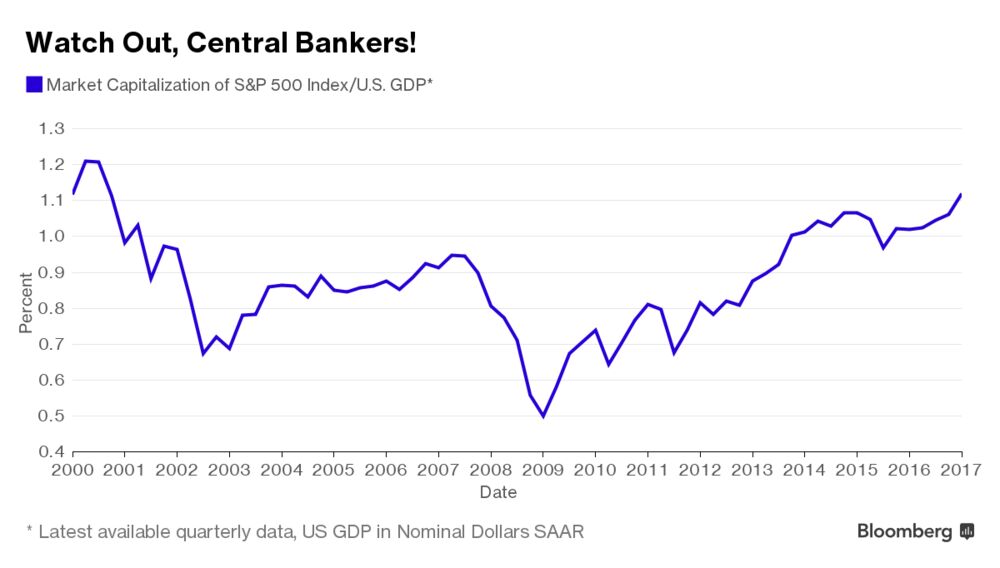
Says U.S. market cap to GDP ratio highest since 2000
Stocks could rise higher after next month’s French election
Guggenheim's Minerd Warns of 'Significant Correction' Billionaire investor Paul Tudor Jones has a message for Janet Yellen and investors: Be very afraid.
The legendary macro trader says that years of low interest rates have bloated stock valuations to a level not seen since 2000, right before the Nasdaq tumbled 75 percent over two-plus years. That measure --the value of the stock market relative to the size of the economy -- should be “terrifying” to a central banker, Jones said earlier this month at a closed-door Goldman Sachs Asset Management conference, according to
people who heard him.
Jones is voicing what many hedge fund and
other money managers are privately warning investors: Stocks are trading
at unsustainable levels. A few traders are more explicit, predicting a
sizable market tumble by the end of the year.
Last week, Guggenheim Partner’s Scott Minerd said he expected
a “significant correction” this summer or early fall. Philip Yang, a
macro manager who has run Willowbridge Associates since 1988, sees a
stock plunge of between 20 and 40 percent, according to people familiar
with his thinking.
Even Larry Fink, whose BlackRock Inc. oversees
$5.4 trillion mostly betting on rising markets, acknowledged this week
that stocks could fall between 5 and 10 percent if corporate earnings
disappoint.
Caution Flags
Their views aren’t widespread. They’ve seen the carnage suffered by a few money managers who have been waving caution flags for awhile now, as the eight-year equity rally marched on.
But
the nervousness feels a bit more urgent now. U.S. stocks sit 2 percent
below the all-time high set on March 1. The S&P 500 index is trading
at about 22 times earnings, the highest multiple in almost a decade,
goosed by a post-election surge.
Managers expecting the worst each
have a pet harbinger of doom. Seth Klarman, who runs the $30 billion
Baupost Group, told investors in a letter last week that corporate
insiders have been heavy sellers of their company shares. To him, that’s
“a sign that those who know their companies the best believe valuations
have become full or excessive.”
Share sales by insiders outstripped purchases by $38 billion in the first quarter, the most since 2013, according to The Washington Service, a provider of data and analysis on insider trading.
Klarman also noted that margin debt -- the money clients borrow from their brokers to purchase shares -- hit a record
$528 billion in February, a signal to some that enthusiasm for stocks
may be overheating. Baupost was a small net seller in the first quarter,
according to the letter.
Another multi-billion-dollar hedge fund
manager, who asked not to be named, said that rising interest rates in
the U.S. mean fewer companies will be able to borrow money to pay
dividends and buy back shares. About 30 percent of the jump in the
S&P 500 between the third quarter of 2009 and the end of last year
was fueled by buybacks, according to data compiled by Bloomberg
Intelligence. The manager says he has been shorting the market,
expecting as much as a 10 percent correction in U.S. equities this year.
China Slowdown
Other
worried investors, like Guggenheim’s Minerd, cite as potential triggers
President Donald Trump’s struggle to enact policies, including a tax
overhaul, as well as geopolitical risks.
Yang’s prediction of a
dive rests on things like a severe slowdown in China or a
greater-than-expected rise in inflation that could lead to bigger rate
hikes, people said. Yang didn’t return calls and emails seeking a
comment.
Even billionaire Leon Cooperman -- long a stock bull --
wrote to investors in his Omega Advisors that he thinks U.S. shares
might stand still until August or September, in part because of flagging
confidence in the so-called Trump reflation trade. But, they’ll eventually resume their climb and end the year moderately higher, he and vice chairman Steven Einhorn wrote in the letter.
When
asked Friday about Jones’s comments, Fed Vice Chairman Stanley Fischer
told CNBC, “There are lots of things that terrify me -- stock market
volatility of the magnitude that we’ve seen for the last couple of years
doesn’t,” without addressing valuations. “Of course we’ll watch very
closely and if we see excess volatility, wonder what is behind it and
whether there are structural features that need fixing or whether it’s
simply recent events or even policy actions.”
Likely Culprit
While Jones, who runs the $10 billion Tudor
Investment hedge fund, is spooked, he says it’s not quite time to short.
He predicts that the Nasdaq, which has already rallied almost 10
percent this year, could edge higher if nationalist candidate Marine Le
Pen loses France’s presidential election next month as expected. Jones
tripled his money in 1987 in large part by correctly calling that
October’s market crash.
While the billionaire didn’t say when a
market turn might come, or what the magnitude of the fall might be, he
did pinpoint a likely culprit.
Just as portfolio insurance caused
the 1987 rout, he says, the new danger zone is the half-trillion dollars
in risk parity funds. These funds aim to systematically spread risk
equally across different asset classes by putting more money in lower
volatility securities and less in those whose prices move more
dramatically.
Because risk-parity funds have been scooping up
equities of late as volatility hit historic lows, some market
participants, Jones included, believe they’ll be forced to dump them
quickly in a stock tumble, exacerbating any decline.
“Risk parity,” Jones told the Goldman audience, “will be the hammer on the downside.”
Before it's here, it's on the Bloomberg Terminal.LEARN MORE
BOSTON— Jack Meyer trounced rivals when he ran Harvard
University’s endowment in the 1990s. But as a hedge-fund manager, he is
struggling. His Convexity Capital Management LP has lost $1 billion of its
clients’ money over the last few years as once reliable options trades
backfired. Investors pulled more than $3.5 billion from the bond shop
last year, its fifth down year in a row. The firm laid off a tenth of
its staff in recent months.
This is one of the most frustrating aspects of the investment
management business. Performance does not persist and strategies, upon
becoming successful, can often start to fail once enough imitators show
up or the market wizens up about someone keeping a big, giant edge to
themselves.
Almost no one has been able to keep their edge in this game
over the years. It’s weird that investors expect this kind of
persistence from hot managers when they have so many examples in the
world outside of finance that demonstrate how unrealistic this sort of
thing is.
Let’s just mention professional athletes, as an example. For obvious
reasons, investing in Kobe or Jeter after 15 years of stellar
performance wouldn’t make any sense to anyone. Why do we think a fund
manager’s track record would be any more relevant?
The best managers have been the most adaptable.
Warren Buffett went
from owning passive stakes in high quality blue chip companies to
acquiring them outright (see Burlington Northern Railroad). Then he
moved on to becoming a private equity partner in the LBOs of others (see
Heinz).
Carl Icahn went from options market guru to activist hedge
fund. But activism got crowded, so now he’s adapted. The new strategy
appears to be making friends with the President of the United States and
pushing for favorable regulatory changes to enhance the value of public
companies he owns (see CVR Energy). Carl and Warren have been finding new edges and opportunities for decades and decades, but they are exceptional.
Not all investors have the capability of adapting their strategies.
Most are more likely to stick to what they’re doing until it stops
working, and then they keep going anyway. You can convince institutional
investors that you’ve made money for that you’re only cyclically
(temporarily) out of favor for a long time before they give up on you,
especially if you’re a name brand.
Even if you do attempt to adapt, there’s no guarantee it will work.
Lots of long-short hedge fund kings have been unable to generate the
type of reliable alpha that has been legislated out of existence by the
onset of Reg FD (Fair Disclosure). It just took a decade or so for this
to become apparent. And in the meantime, their pivots into macro
strategies have been mostly disastrous.
When you’re looking at the performance record of a firm like
Renaissance Technologies, it’s tempting to believe that they’ve built an
unstoppable alpha machine that could run itself, it’s so consistent.
But this is hardly the case. Every day there are hundreds of PhDs and
other assorted geniuses showing up to their cabin in the woods to keep
coming up with new edges. Because the old ones eventually stop working.
There are no alpha machines, there are only tools and systems that may
allow them to find alpha somewhere new.
This is not the sort of enterprise in which thousands of
professionals and organizations will thrive. There simply isn’t enough
room. It’s a small, rarefied world with enormous potential rewards being
chased by millions. Maintaining an edge is unrealistic, but finding new
edges on a regular basis may be even more unrealistic.
Full
Disclosure: Nothing on this site should ever be considered to be
advice, research or an invitation to buy or sell any securities, please
see my Terms & Conditions page for a full disclaimer.
A chat bot that helped overturn 160,000 parking tickets is now giving free legal aid to asylum-seeking refugees through Facebook.
DoNotPay,
which has been dubbed the world’s first robot lawyer, was created by
London-born Stanford University student Joshua Browder.
The
20-year-old, who has made Forbes’ 30 Under 30 list of the brightest
young entrepreneurs, designed his first bot to help people fight parking
fines.
Now the
‘Robin Hood of the internet’ has just expanded the chat bot to Facebook
Messenger to help refugees in the US, Canada and the UK claim asylum.
“Ultimately, I just want to level the playing field so there’s a bot for everything,” he told Business Insider.
“I
originally started with parking tickets and delayed flights and all
sorts of trivial consumer rights issues,” he added. “But then I began to
be approached by these non-profits and lawyers who said the idea of
automating legal services is bigger than just a few parking fines. So
I’ve since tried to expand into doing something more humanitarian.”
The
bot asks users a series of questions in real time, such as “Have you,
your family or colleagues ever experienced harm or threats?”
It
helps refugees seeking asylum in the United States or Canada complete
the necessary forms and those applying in the UK, who will then have to
apply in person, with the support documents.
He
added: “The success of the parking tickets has made me realise this is
bigger than parking charges. I think there’s a real value in providing
free legal help through a chat bot.”
FILE PHOTO: Professional sports gambler William ''Billy'' Walters departs Federal Court after a hearing in Manhattan, New York City, New York, U.S., July 29, 2016. REUTERS/Andrew Kelly/File Photo
U.S. | Fri Apr 7, 2017 | 3:38pm EDT Las Vegas sports gambler Walters convicted of insider trading
Famed Las Vegas sports gambler William "Billy" Walters was convicted on Friday of insider trading charges in a scheme that prosecutors said enabled him to make more than $40 million and involved a stock tip to star professional golfer Phil Mickelson.
In their second day of deliberations, jurors found Walters, 70, guilty on all 10 counts he faced, including securities fraud, wire fraud and conspiracy, following a three-week trial in federal court in Manhattan.
"Today, Billy Walters lost his bet that he could cheat the securities markets and get away with it scot-free," acting U.S. Attorney Joon Kim said in a statement. Walters, who built a fortune as one of the most successful U.S. sports bettors, expressed disbelief to reporters after hearing the six-man, six-woman jury's verdict. "If I had made a bet I would have lost. I just did lose the biggest bet of my life," Walters said. "Frankly I'm in total shock."
Barry Berke, Walters' lawyer, said he would appeal. Walters is scheduled to be sentenced on July 14. Walters was charged in May after a high-profile probe focused on what prosecutors called his scheme to obtain confidential tips about Dean Foods Co from its chairman, Thomas Davis. Prosecutors said that from 2008 to 2014, Walters generated $32 million of profit and avoided $11 million of losses by trading on inside information about Dean Foods from Davis. Walters earned another $1 million trading on a tip about Darden Restaurants Inc, operator of the Olive Garden restaurant chain, they said. Davis, who testified against Walters as part of a plea deal, told jurors he passed tips ahead of Dean Foods' earnings reports and a 2012 spinoff of part of its business, using "burner" phones.
Prosecutors said Walters at one point made a recommendation to Mickelson that the golfer, who at the time owed him a gambling debt, buy Dean Foods stock. Mickelson was not accused of wrongdoing and did not testify at trial, but he reached an agreement with the U.S. Securities and Exchange Commission in2016 to pay back $1.03 million the regulator said he earned trading the dairy company's stock.
At trial, Berke argued Davis had lied to get a sweetheart deal for himself. He contended -
Walters won big as a stock trader the same way he did as a sports gambler - with diligent research and keen instincts.
The case is U.S. v. Davis et al, U.S. District Court, Southern District of New York, No. 16-cr-00338.
(Reporting by Nate Raymond and Brendan Pierson in New York; Editing by Leslie Adler and Lisa Shumaker)