Greed and Capitalism

What kind of society isn't structured on greed? The problem of social organization is how to set up an arrangement under which greed will do the least harm; capitalism is that kind of a system.
- Milton Friedman

Thursday, April 14, 2016

Pharmaceutical Stock Price Manipulation: Anavex Plays the Orphan Drug Stock Promotion Game

One more angle for selling shares....are these companies almost breaking 'Blue Sky Laws' for news releases, by implying value and meaning in the orphan drug designation?

Anavex Plays the Orphan Drug Stock Promotion Game

By Adam Feuerstein Follow | 04/12/16 

I'm in a fighting mood, so let's get into it with Anavex Life Sciences (AVXL) over last week's stock promotion stunt, tied to its meaningless "The FDA Awarded Us Orphan Drug Designation!" press release.

Too many investors have a fundamental misunderstanding about the significance of orphan drug designation. I should say, insignificance, because the FDA delineation, on its own, means very little. 

Yet almost every day, biotech companies like Anavex issue press releases touting orphan drug designation as if it were an achievement of supreme importance.

It's not, and I'll explain why below.

Anavex issued said press release on Friday. It contains a wee bit of truth. On April 6, the U.S. Food and Drug Administration granted orphan drug designation to the company's experimental compound Anavex 3-71 for the treatment of frontotemporal dementia.

But then, Anavex goes off the rails with this canned quote from Kristina Capiak, vice president of regulatory affairs: "We believe that Orphan Drug Designation for Anavex 3-71 for the treatment of frontotemporal dementia is a significant achievement."

Sure, if you consider answering eight questions on a standardized Food and Drug Administration form to be a "significant achievement."

Answer eight questions on an FDA form. Do it correctly. Make two copies of the form. Send to FDA. That's all it takes for any biotech and drug company to secure orphan drug designation from the FDA. It's really that easy.

Is that a "significant achievement"? No, except if your ulterior motive is to hoodwink gullible retail investors into buying your stock.

Let's tell some truths about orphan drugs and the FDA.

The Orphan Drug Act was enacted to incentivize drug makers to develop new treatments for rare diseases, defined as a disease affecting 200,000 patients or fewer.

The FDA grants seven years of market exclusivity to an orphan drug, if it is approved. Companies developing orphan drugs also get priority review, research tax credits and a waiver of FDA fees.

Drug companies like the goodies that come with developing orphan drugs, but what they love most is the ability to charge really high prices for approved orphan drugs -- and not worry too much about reimbursement headaches from insurance companies. 

Lots of companies want to emulate the biotech sector's most successful orphan drug developers like Alexion Pharmaceuticals (ALXN - Get Report) , which charges $500,000 or more per year for Soliris, a drug that treats several rare blood diseases.

The FDA granted 354 orphan drug designations in 2015, a 22% increase over 2014. During last week alone, seven other drugs were granted orphan drug designation in addition to Anavex-371. You can search the FDA's orphan drug database here.


Orphan drug designation is the starting point in the regulatory process. It's the acknowledgement drug makers get from the FDA that their experimental compound will be eligible for orphan drug benefits -- IF IT IS APPROVED.

That last bit is the kicker. Orphan drug designation doesn't mean the FDA favors a drug or believes a drug will be approved. 

Let me repeat that: If you believe orphan drug designation connotes favor from FDA or correlates in any way with higher approval chances or proven benefit for patients, you are sadly misinformed.

I wasn't joking earlier when I said securing orphan drug designation requires a company to answer eight questions on an FDA form. Here's the FDA instruction form: How to Apply for Orphan Drug Designation.

There are eight questions. Simple. Need help? The FDA provides it here: Tips for Submitting an Application for Orphan Designation.

Only question No. 4 requires significant work. In addition to providing the FDA with a description of the drug's active moiety or molecular structure, the agency asks companies to submit the following:

A discussion of the scientific rationale to establish a medically plausible basis for the use of the drug for the rare disease or condition, including all relevant data from in vitro laboratory studies, preclinical efficacy studies conducted in an animal model for the human disease or condition, and clinical experience with the drug in the rare disease or condition that are available to the sponsor, whether positive, negative, or inconclusive. 

Animal toxicology studies are generally not relevant to a request for orphan-drug designation. 

Copies of pertinent unpublished and published papers are also required.

The FDA doesn't care if the data submitted is "positive, negative or inconclusive." As long as a company can make a "medically plausible" case for the drug treating a rare disease and provide coherent responses to seven other easy questions, the FDA will grant orphan drug designation.

To Anavex, achieving orphan drug designation for Anavex 3-71 is a "meaningful achievement." To everyone else, it's a homework assignment.

I can list a few real companies with drugs awarded orphan drug designation which later blew up or were rejected by the FDA.

BioMarin's (BMRN - Get Report) drisapersen received an orphan drug designation from the FDA. Drisapersen was also anointed with a rare pediatric disease designation, fast track status, priority review and breakthrough therapy designation. The FDA rejected drisapersen.

Catalyst Pharmaceuticals' (CPRX) Firdapse received orphan drug designation and breakthrough therapy designation. The FDA issued Catalyst a refuse-to-file letter for Firdapse, meaning the new drug application was insufficient for review.

Celldex Therapeutics' (CLDX - Get Report) rindopepimut was designated orphan drug and breakthrough therapy. Rindopepimut failed in a phase III study and is now being put on the shelf.
Anavex hasn't even tested Anavex 3-71 in humans yet. The orphan drug designations means nothing.

Adam Feuerstein writes regularly for TheStreet. In keeping with company editorial policy, he doesn't own or short individual stocks, although he owns stock in TheStreet. He also doesn't invest in hedge funds or other private investment partnerships. Feuerstein appreciates your feedback; click here to send him an email.
 
Source: http://www.thestreet.com/story/13524933/1/anavex-plays-the-orphan-drug-stock-promotion-game.html?utm_source=Sailthru&utm_medium=email&utm_campaign=Issue:%202016-04-13%20BioPharma%20Dive%20[issue:5542]&utm_term=BioPharma%20Dive


Brand New – TheStreet's Biotech Bible! Before you invest one single dime in any biotech stock you have got to KNOW WHAT YOU ARE BUYING! Get THE most comprehensive text covering the 171 biotech companies that have gone public since 2013! There’s nothing else like it for digging into this highly speculative group of stocks.  Get a FREE copy today!

Wednesday, April 6, 2016

Definition of tax inversion.


Definition of tax inversion. A transaction used by a company whereby it becomes a subsidiary of a new parent company in another country for the purpose of falling under beneficial tax laws. Typically they are used by US companies to move to lower tax domiciles, in Europe in particular.

Tax Inversion Definition from Financial Times Lexicon

lexicon.ft.com/Term?term=tax-inversion


Sunday, March 13, 2016

Hewitt Heiserman: "Ben Graham and the Growth Investor" | Talks at Google


Published on Mar 8, 2016
Hewitt
Heiserman authored "It's Earnings That Count" and is finishing his
second book, “The Checklist Investor”. He is a member of the Boston
Security Analyst Society and CFA Institute. He has written for several
investing publications.. He graduated from Kenyon College and received
the Faculty Award for Distinguished Achievement. He is an Ironman
finisher, and is active in open land preservation.

The slides to pair with this talk can be found at: https://goo.gl/kg1BtL


Hewitt Heiserman: "Ben Graham and the Growth Investor" | Talks at Google


Published on Mar 8, 2016
Hewitt
Heiserman authored "It's Earnings That Count" and is finishing his
second book, “The Checklist Investor”. He is a member of the Boston
Security Analyst Society and CFA Institute. He has written for several
investing publications.. He graduated from Kenyon College and received
the Faculty Award for Distinguished Achievement. He is an Ironman
finisher, and is active in open land preservation.

The slides to pair with this talk can be found at: https://goo.gl/kg1BtL


Friday, March 4, 2016

Canada is the only G7 country without a stockpile of at least hundreds of tonnes of gold.


Canada’s gold stash down to last bit as it almost empties reserves

Canada’s official holdings of the precious metal now amounts to just a few dozen ounces after it nearly sold 22,000 ounces of gold coins in February.

One hundred gram gold bars at Gold Investments in London in 2014. Data from the World Gold Council suggest Canada stands apart from its industrialized peers as the only G7 country without a stockpile of at least hundreds of tonnes of gold.
Chris Ratcliffe / Bloomberg 

One hundred gram gold bars at Gold Investments in London in 2014. Data from the World Gold Council suggest Canada stands apart from its industrialized peers as the only G7 country without a stockpile of at least hundreds of tonnes of gold. 

Tuesday, March 1, 2016

What Are Newmont Mining's Acquisitions Plans?


Newmont Says Every $100 Gold Gain Adds $350 Million to Cash Flow


  • `I'm very comfortable with our debt structure': CEO Goldberg
  • Company is still bullish on gold prices in long term


“I’m very comfortable with our debt structure overall,” Goldberg said. “We’re still bullish long term for gold.”

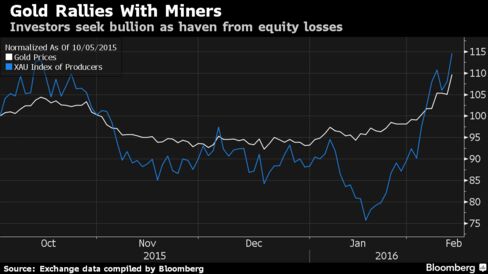
Gold advanced 10 percent since the end of January on Comex in New York, poised for the biggest February gain since futures trading data began in 1975. Turmoil across global equity and currency markets has sparked demand for a haven.

At the same time, there is increasing doubt that the Federal Reserve will move as quickly as it planned to raise rates because the expansion may weaken. That increases the allure of bullion as a store of value. Prices fell in the previous three years, reaching a five-year low in December as Fed officials increased borrowing costs for the first time in almost a decade.

“As long as real interest rates stay down below 3 percent a year, that’s generally good for gold,” Goldberg said. At “$1,200 or $1,300 an ounce, we still see it as a good price where we can deliver good free-cash flow and dividends back to shareholders."

While larger rival Barrick Gold Corp. has been selling assets, Newmont has responded to a prolonged slump in gold prices by continuing to expand. In June, the company agreed to buy the Cripple Creek & Victor mine in Colorado for $820 million and in October it announced plans to expand its Tanami operations in Australia.

Buying more assets would depend “on the value of the opportunity, if it makes sense long term,” Goldberg said in an interview on Bloomberg Television.


What Are Newmont Mining's Acquisitions Plans?


Link: http://www.bloomberg.com/news/articles/2016-02-29/newmont-says-every-100-gold-gain-adds-350-million-to-cash-flow


Warning of a Crash - strategy has become too popular


Opinion: ‘Smart-beta’ investing guru is now warning of a crash

Published: Feb 25, 2016


Rob Arnott says the popular strategy has become too popular


By

Columnist

Dump “quality” stocks and buy “value” stocks.

That’s the call from Rob Arnott, the legendary financial guru and chairman of Research Affiliates, an investment firm in Newport Beach, Calif.

He says stocks bearing high-quality characteristics — such as high profits, strong balance sheets and so on — have now become far too expensive in relation to the rest of the stock market.

Meanwhile, so-called “value” stocks — which generally mean boring companies that have low future growth prospects but are cheap in relation to current profits and dividends — are at one of their biggest discounts in modern history.
Arnott’s latest research is a salutary warning that smart beta, like anything, is subject to the laws of financial gravity, known in the trade as ‘mean reversion.’


Arnott’s call may be useful for investors looking to find the best bargains. But how he reaches this conclusion is equally fascinating.

The big trend in investing since the financial crisis has been the discovery of so-called “smart beta,” which means investing in stocks based on characteristics like low volatility, high quality and high momentum.

A ton of academic research has found that such strategies would have earned you higher returns with lower risk over many decades if you had followed them.

As a result, there’s been a flood of mutual funds, exchange traded funds and institutional portfolios designed to help investors profit from the “alpha” of “smart beta” — which is Wall Street jargon for saying they hope to make you lots of money.

Arnott was among the pioneers of this research, and is one of the most respected names in finance. So why has he turned against it?

Simple. Smart beta has become so popular, it’s now dangerous, he says. Indeed, a “smart-beta crash” is now “reasonably likely,” he warns.

A stock is worth only the present value of its future cash flow, just as, say, investment property is worth only the present value of its future net rents.

The more you pay for the investment, the less a bargain it is. During a mania, a fad or a bubble, people end up paying too much. So even though the future cash flow (or net rents) flow through, the investor loses money.

Historically, you’ve done very well if you invested in the stocks of companies that had high business quality (such as high profits, low debts, stability and so on), and in stocks that had low volatility. You made more money, with less risk, over time. Hence the rise of “smart-beta” strategies that targeted such stocks.

But as more people discovered these phenomena, they joined in the demand for smart-beta stocks – and drove up the price. At some point, while the business remains one with high quality or low volatility, the stock


 Source: http://www.marketwatch.com/story/smart-beta-investing-guru-is-now-warning-of-a-crash-2016-02-25


Monday, February 29, 2016

Warren Buffett: Don't make this mistake...


× Warren Buffett: Don't make this mistake... Embed this video Video Embed Size: 530 X 298 640 X 360 Warren Buffett: Don't make this mistake... 20 Hours Ago It's a terrible mistake when buyers sell stocks based on what they think businesses are going to do next month or next year, says Warren Buffett, Berkshire Hathaway CEO, the country...


Warren Buffett: Don't make this mistake...

20 Hours Ago


It's a terrible mistake when buyers sell stocks based on what they think businesses are going to do next month or next year, says Warren Buffett, Berkshire Hathaway CEO, the country...


Link: http://video.cnbc.com/gallery/?video=3000497592