
Investor. Any references to securities are not recommendations or solicitations to buy or sell anything. I may have positions in securities mentioned.
Friday, December 26, 2014


Thursday, December 25, 2014

Marketing Quotes
At the heart of great story is emotion.
@ThamKhaiMeng
Worldwide Chief Creative Officer at Ogilvy & Mather. Tweets are all mine, except the ones you write.
- Marc Chagall
When we want to persuade someone and move them, we talk to their heart not their head, using stories. http://shr
We're more connected now than ever, and we're less connected now than ever - a paradox. Thanks for the pic, Banksy.
Wednesday, December 24, 2014
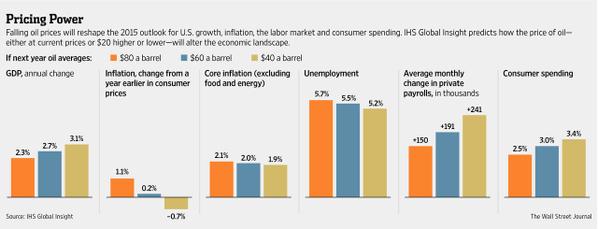
Oil Price Projections
How would the U.S. economy fare with oil averaging $40, $60 and $80 next year?
Bitcoin disaster

The Inside Story of Mt. Gox, Bitcoin's $460 Million Disaster | WIRED http://www.wired.com/2014/03/bitcoinn-exchange/ nn…

Monday, December 22, 2014
BlackBerry: A Rising Phoenix?

The BlackBerry Q10 is small enough to grip with one hand.
BlackBerry: A Rising Phoenix?
MOBILERitika Puri
JUNE 25, 2014
Once upon a time, BlackBerry ruled the corporate communication ecosystem.
Today, technologists call the former mobile giant a “has been” with a market share that has fallen below one percent in the United States and close to zero percent in China.
But hope is not lost. BlackBerry aficionados swear that the once-mobile giant will make a comeback in today’s new world of work — and that 2014 is the year it will happen.
Despite claims that BlackBerry is on its last legs, the company continues to trudge ahead as a force to be reckoned with. But is persistence enough to fuel the company’s comeback? And if so can it regain a share of the ever-demanding and always-changing business professional market?
Never say never.
DISMAL — BUT NOT THAT DISMAL
BlackBerry CEO John Chen gave the company a 50% chance of rebounding. Then, a funny thing happened. In Q4 2013, BlackBerry shocked Wall Street by beating low end estimates — and witnessing a 24% increase in its stock price. Stock prices in Q2, according to Yahoo! Finance, have decreased slightly and are currently hovering between $7 and $8 per share.
As Mashable’s Todd Wasserman reported, Chen has focused on trimming costs to streamline BlackBerry’s operations, resulting in an increase in gross margin to 43% from 34% in Q3 2014.
BlackBerry is also expanding into new, growing markets including Asia and Latin America.
RELENTLESS FOCUS
Android and iOS devices are consumer-first devices. Their applications extend to multiple segments – designed for a variety of use cases.
BlackBerry, on the other hand, claims that it knows the enterprise market better than any other brand.
In an interview with FierceMobileIT, BlackBerry’s Jeff Holleran explained:
“We are focused on what we consider our core business in enterprise in the large and regulated industries, such as financial and healthcare companies and government agencies. We are able to meet their needs for an end-to-end mobility solution that isn’t possible with any other mobile platform out there today. We also want to fill the need of the users in non-regulated industries that may have the opportunity to have a BYOD device.”
The security and logistical considerations of BYOD are a major pain point for almost every enterprise organization — a need that BlackBerry understands well.
The question is whether the focus BlackBerry provides will ultimately outweigh the customization potential for Android and iOS.
TIMELESS ROOTS
According to Chen, BlackBerry’s future is in the company’s roots. A high-end keyboard is what sparked the much-loved smartphone to take off — and now, the company is realizing that keyboards are what customers want most. Chen said the company is acting on the customer desire:
“I personally love the keyboards. So you will look to Blackberry going forward to do keyboards — I wouldn’t use the word exclusively, but predominantly.”
Chen plans to target government and corporate audiences who value a tactile typing experience – and according to reports from numerous sources including USA Today, Chen has confirmed the next phone, the Passport, to be “a box-like” device. The keyboard is designed to be touch sensitive – but albeit, difficult to squeeze in your pocket.
The question, however, is how big this market actually is — especially with the rise of millennial corporate consumers who are highly comfortable with their beloved touch-screens.
Is BlackBerry on to something or simply out of options?
Will businesses embrace the return of its once beloved technology or has today’s highly transformative workplace moved too far into the future?
Time will tell the answer.
Once upon a time, BlackBerry ruled the corporate communication ecosystem.
Today, technologists call the former mobile giant a “has been” with a market share that has fallen below one percent in the United States and close to zero percent in China.
But hope is not lost. BlackBerry aficionados swear that the once-mobile giant will make a comeback in today’s new world of work — and that 2014 is the year it will happen.
Despite claims that BlackBerry is on its last legs, the company continues to trudge ahead as a force to be reckoned with. But is persistence enough to fuel the company’s comeback? And if so can it regain a share of the ever-demanding and always-changing business professional market?
Never say never.
DISMAL — BUT NOT THAT DISMAL
BlackBerry CEO John Chen gave the company a 50% chance of rebounding. Then, a funny thing happened. In Q4 2013, BlackBerry shocked Wall Street by beating low end estimates — and witnessing a 24% increase in its stock price. Stock prices in Q2, according to Yahoo! Finance, have decreased slightly and are currently hovering between $7 and $8 per share.
As Mashable’s Todd Wasserman reported, Chen has focused on trimming costs to streamline BlackBerry’s operations, resulting in an increase in gross margin to 43% from 34% in Q3 2014.
BlackBerry is also expanding into new, growing markets including Asia and Latin America.
RELENTLESS FOCUS
Android and iOS devices are consumer-first devices. Their applications extend to multiple segments – designed for a variety of use cases.
BlackBerry, on the other hand, claims that it knows the enterprise market better than any other brand.
In an interview with FierceMobileIT, BlackBerry’s Jeff Holleran explained:
“We are focused on what we consider our core business in enterprise in the large and regulated industries, such as financial and healthcare companies and government agencies. We are able to meet their needs for an end-to-end mobility solution that isn’t possible with any other mobile platform out there today. We also want to fill the need of the users in non-regulated industries that may have the opportunity to have a BYOD device.”
The security and logistical considerations of BYOD are a major pain point for almost every enterprise organization — a need that BlackBerry understands well.
The question is whether the focus BlackBerry provides will ultimately outweigh the customization potential for Android and iOS.
TIMELESS ROOTS
According to Chen, BlackBerry’s future is in the company’s roots. A high-end keyboard is what sparked the much-loved smartphone to take off — and now, the company is realizing that keyboards are what customers want most. Chen said the company is acting on the customer desire:
“I personally love the keyboards. So you will look to Blackberry going forward to do keyboards — I wouldn’t use the word exclusively, but predominantly.”
Chen plans to target government and corporate audiences who value a tactile typing experience – and according to reports from numerous sources including USA Today, Chen has confirmed the next phone, the Passport, to be “a box-like” device. The keyboard is designed to be touch sensitive – but albeit, difficult to squeeze in your pocket.
The question, however, is how big this market actually is — especially with the rise of millennial corporate consumers who are highly comfortable with their beloved touch-screens.
Is BlackBerry on to something or simply out of options?
Will businesses embrace the return of its once beloved technology or has today’s highly transformative workplace moved too far into the future?
Time will tell the answer.

Warren Buffett - the world's greatest money maker
This is a pretty good docu by BBC.
warren buffett - the world's greatest money maker - finance money biography. thanks for watching
history life discovery science learning education national earth planet channel culture world personal gold silver dollar stock market house housing real estate invest investing investment saving retirement cash coin bar bullion wall street economy economics global trading stocks business rich financial success succeed successful dollars million millionaire billion billionaire
history life discovery science learning education national earth planet channel culture world personal gold silver dollar stock market house housing real estate invest investing investment saving retirement cash coin bar bullion wall street economy economics global trading stocks business rich financial success succeed successful dollars million millionaire billion billionaire
Sunday, December 21, 2014
Business Motivational vpPosters


Synergy concept 1+1=3 made with white chalk on a blackboard.

Hand writing TEAM - Together Everyone Achieves More with white chalk on blackboard.


Success flow chart made with white chalk on a blackboa

Hand writing IDEA - Imagine Dare..

A risk management flow chart handwritten with chalk on a blackboard.

A handwritten business strategy..


Hand drawing Brand concept with.

Hand drawing Business concept with..

Risk Management flow chart with..

The word Internet highlighted with

Hand drawing Change Management..
Hand drawing Change Management..


Hand writing Strategy crossword..

The word Teamwork highlighted with..
Friday, December 19, 2014
Bob Pittman, Chairman and CEO of the global digital and entertainment company, iHeartMedia.(hulu.com)
Bob Pittman, Chairman and CEO of the global digital and entertainment company, iHeartMedia.(hulu.com)
good interview.with Charlie Rose
Link:
Subscribe to:
Posts (Atom)